Guides
What Are the Cabinet Doors Actually Made Of? A No-Jargon Tour
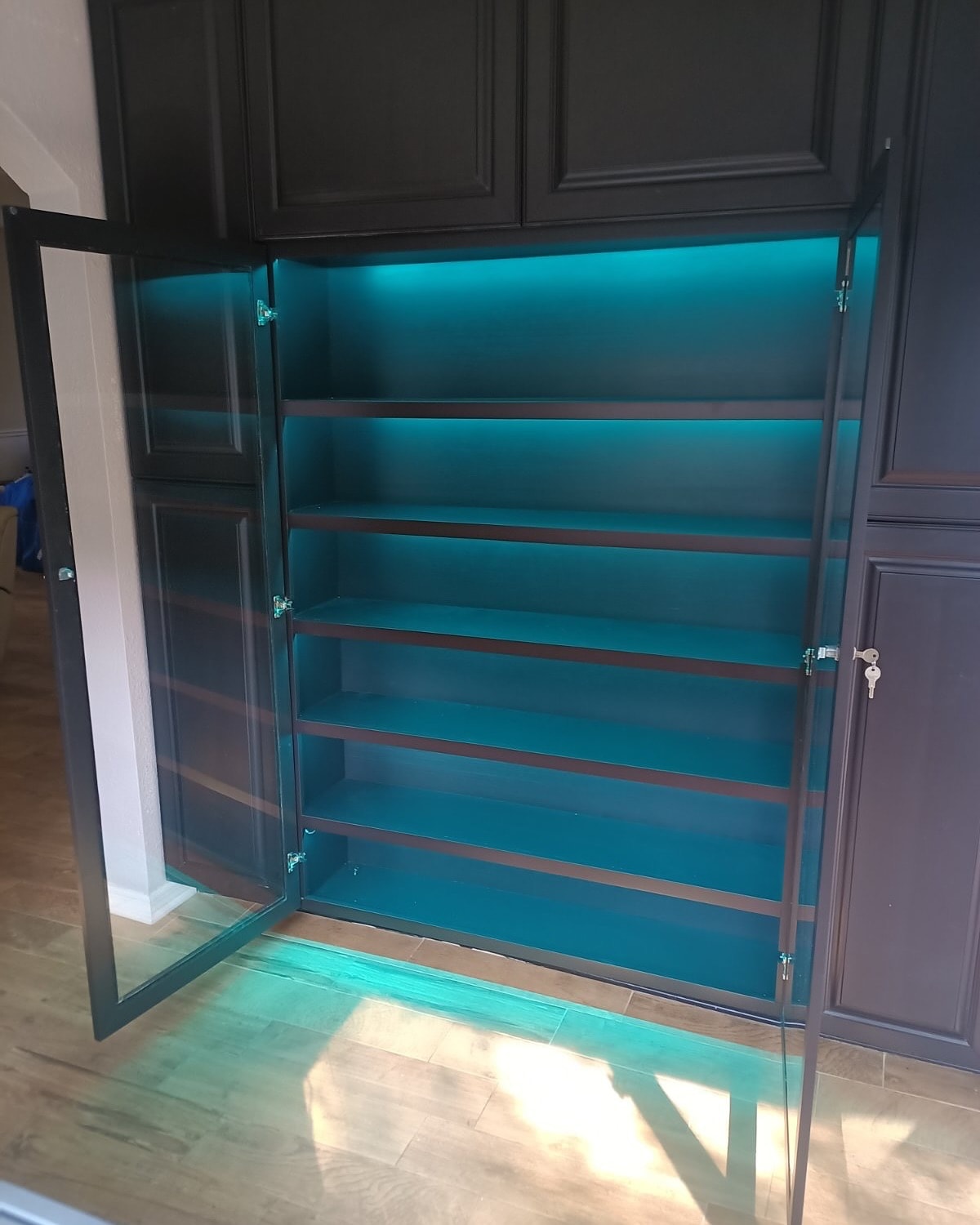
A quote for a custom media wall shows up full of words. MDF here, plywood there, hardwood face frames, maybe "veneer" somewhere. And a quiet worry follows: am I paying custom-furniture money for glorified particleboard?
Fair question. We'd rather answer it plainly than hide behind the terminology. So here's the tour we give clients at the kitchen table: every material in a typical build of ours, what it's for, and why the mix is what you're actually paying for. Not any single material. The mix.
The materials in a typical build, top to bottom
Stand in front of one of our finished walls and you're looking at three or four materials wearing one coat of paint or stain. The doors and flat panels are paint-grade MDF. The cabinet boxes and shelves are hardwood plywood. The face frames, trim, and mantel are solid wood, usually white oak when it's stain-grade. Glass, hardware, and lighting fill in the rest.
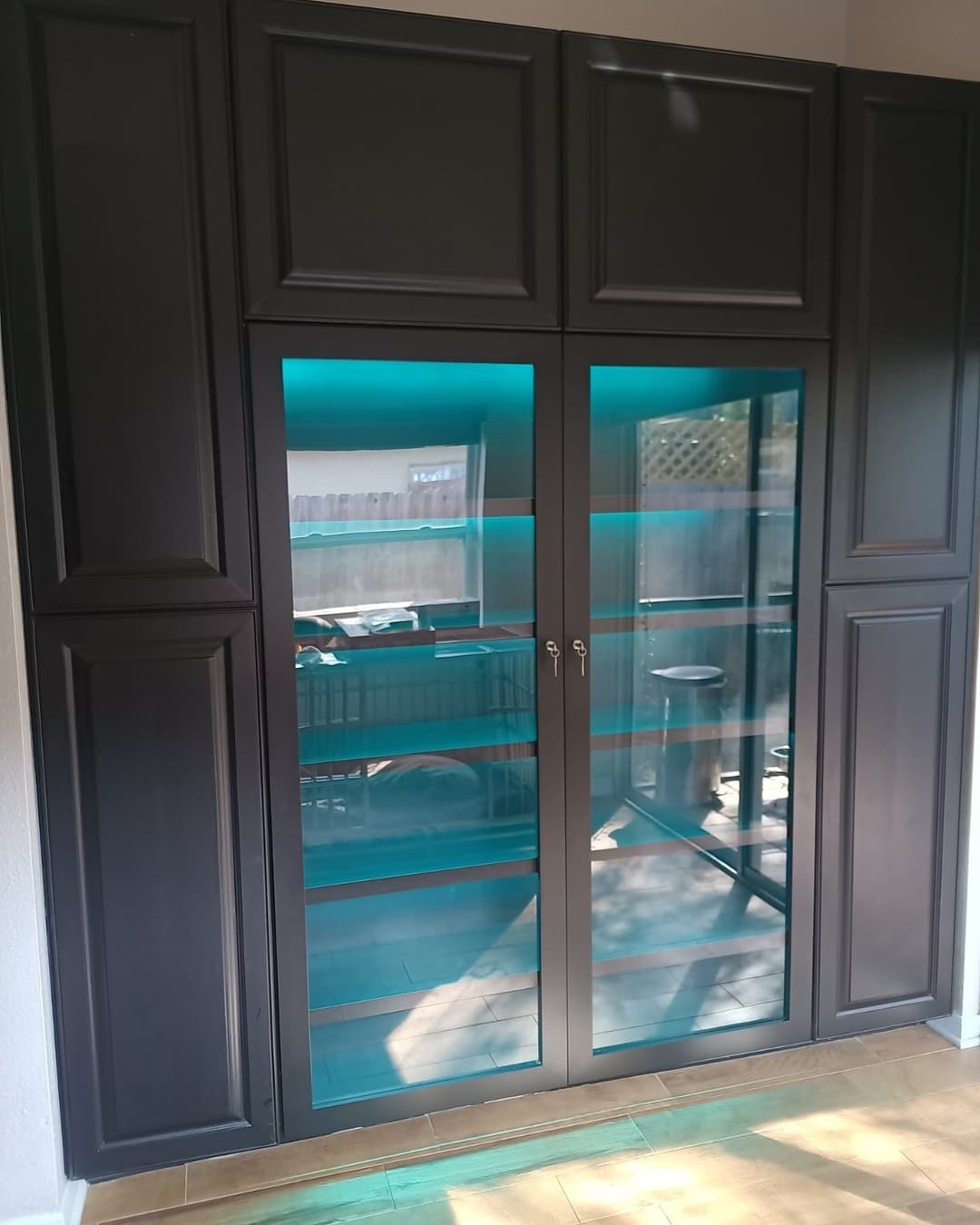
The black display cabinet above is exactly that recipe. Painted doors. Plywood boxes behind them. Solid-wood frames holding the glass, LED-lit shelves inside. There's no single "best" material anywhere in it, just each material doing the one job it's genuinely best at. That's not corner-cutting. That's how good cabinet shops have built for decades.
Doors and panels: why paint-grade MDF is the pro choice
MDF has a reputation problem because the world is full of terrible MDF furniture. But for a painted door or a flat panel, MDF isn't the budget option. It's the correct one. Here's why.
Solid wood moves. It swells and shrinks with humidity, and in Northeast Florida we have humidity to spare. On a painted solid-wood door, that movement eventually telegraphs through as hairline cracks at every joint. MDF is dimensionally stable, dead flat, with no grain to ghost through the finish, so a sprayed MDF door holds that glassy surface for years. Where MDF genuinely fails: shelves (it sags), anything structural, and anywhere it can sit in water. We don't use it in those places.
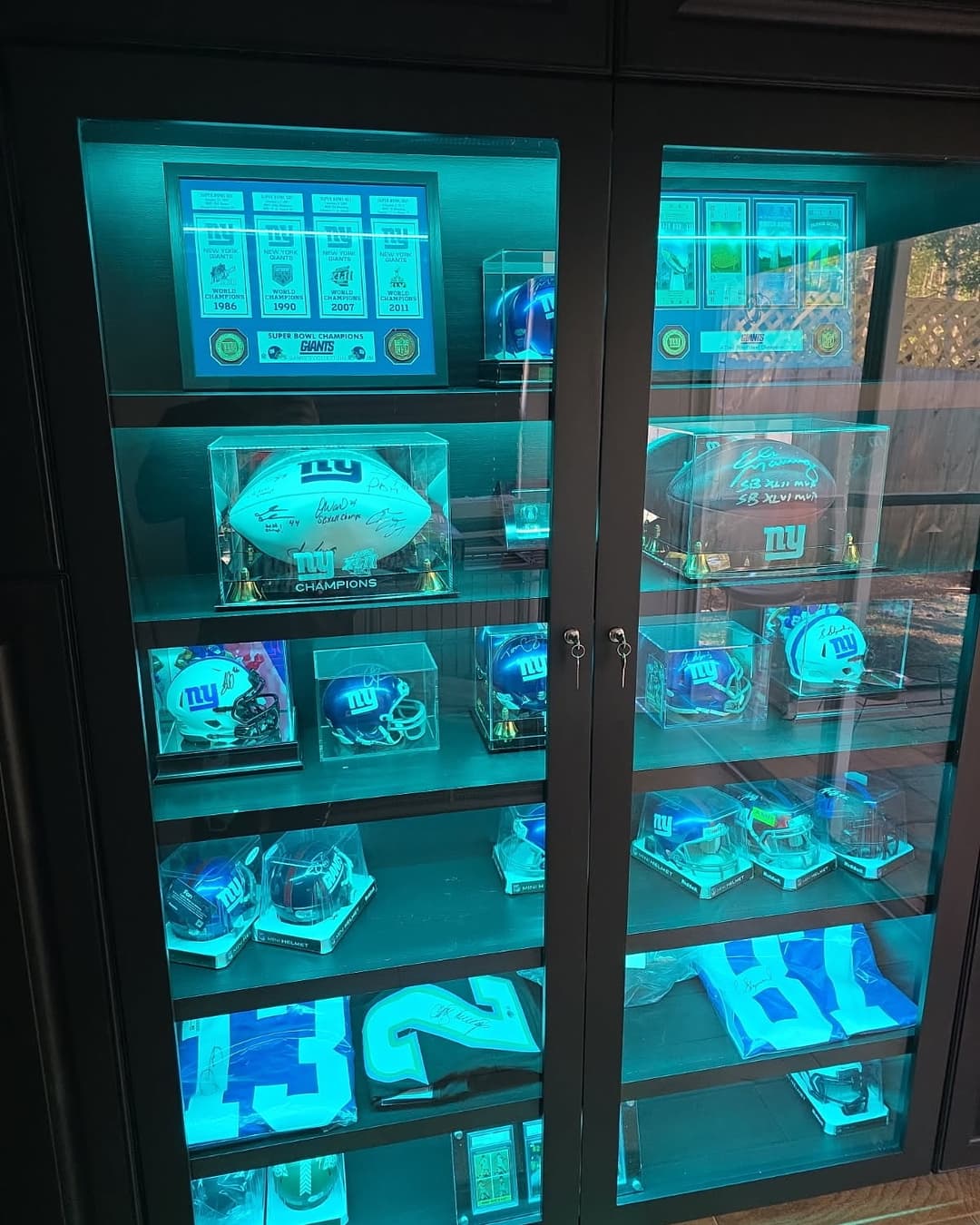
Those crisp black doors and frames above are the payoff. That furniture-grade finish is very hard to get on solid wood and very repeatable on MDF.
Boxes and shelves: plywood earns its keep
The parts you don't see (cabinet boxes, backs, and every shelf) are hardwood plywood in our builds. Plywood is layers of wood glued with alternating grain. That makes it stiff, strong, screw-friendly, and much better behaved in humidity than particleboard or MDF.
This is the spot where cheap builds cut corners, because nobody checks inside the cabinet on install day. You find out two summers later, when a particleboard shelf bows under the board games. When you're comparing quotes, "what are the boxes and shelves made of?" is one of the highest-value questions you can ask. We cover more of those in our guide on how to hire a finish carpenter in Jacksonville.
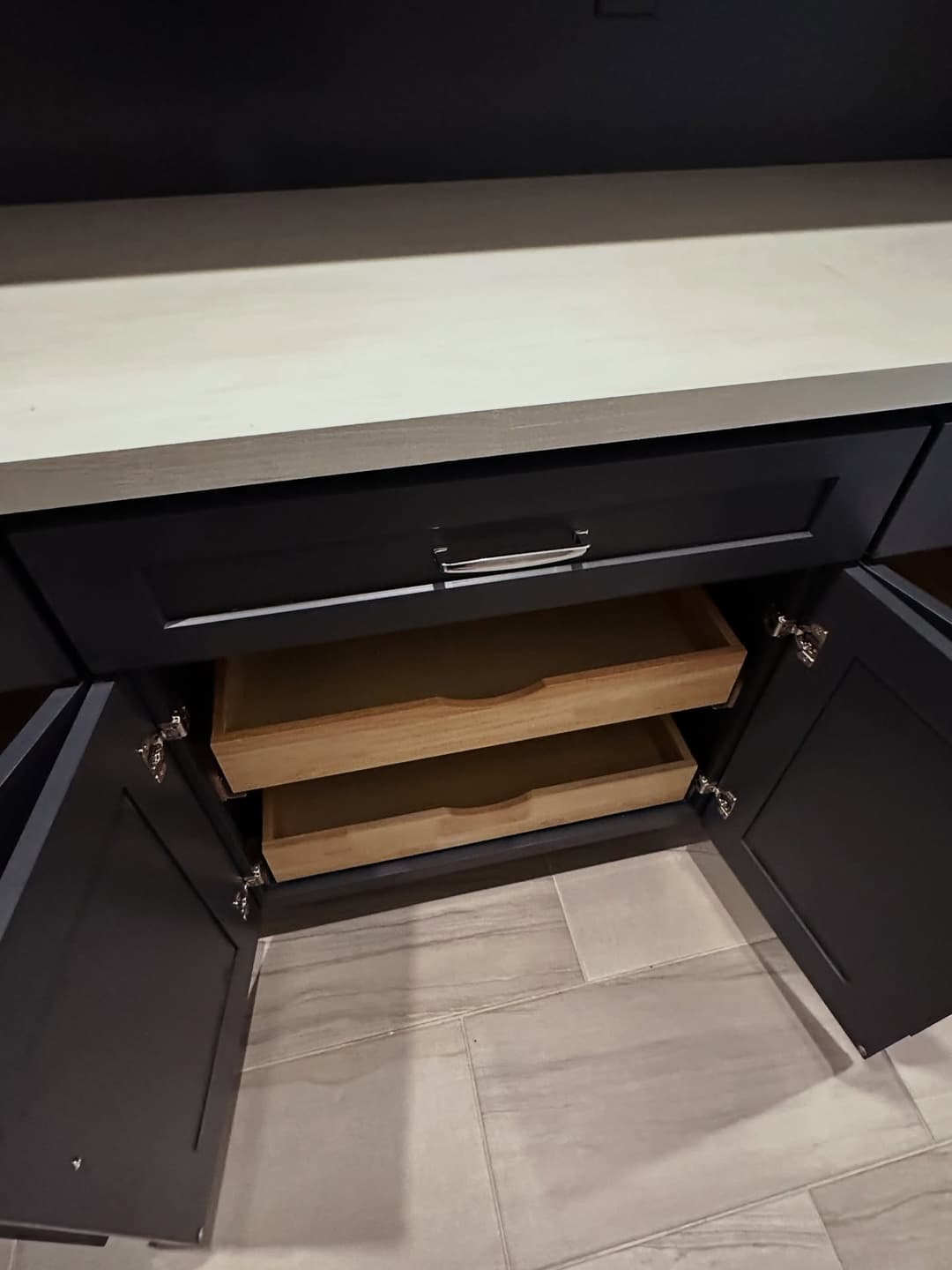
The drawer bank above, pull-outs hiding behind shaker doors, is the kind of hardware-heavy detail that only works long-term when it's mounted in plywood that holds screws for good.
Face frames, trim, and mantels: where solid wood shows up
Solid hardwood goes where hands, vacuums, and dog tails actually make contact: face frames, edge banding on shelf fronts, trim profiles, and anything stain-grade. Edges take the abuse in a cabinet's life, and hardwood shrugs off dings that would crumble an MDF corner.
This is also where "veneer" belongs in the conversation, since the word makes people nervous without much reason. A veneer is a thin layer of real wood glued over a stable core. It's how hardwood plywood gets its face, and it's how fine furniture has been built for centuries. Veneer over plywood is a quality material. Veneer over particleboard, stapled together in a flat-pack factory, is the stuff that gave the word its bad reputation. Same word, very different products. Ask what's under it.
And when a piece is meant to show real grain (a mantel beam, floating shelves, a stained counter) there's no substitute. That's where the white oak comes out. The honest hierarchy isn't "solid wood good, MDF bad." It's paint-grade panels in MDF, structure in plywood, wear edges and stain-grade in hardwood. Nearly every high-end built-in you've admired, including everything on our custom built-ins page, is that hybrid.
How to read a quote like a carpenter
With that map in hand, a quote stops being alphabet soup. Look for three things. First, does it say what the boxes and shelves are made of? If it's silent there, ask. Second, is MDF specified only in painted doors and panels? Good. That's the right call, not a shortcut. Third, does the stain-grade work name a species? "Wood-look" and "wood" are not the same word.
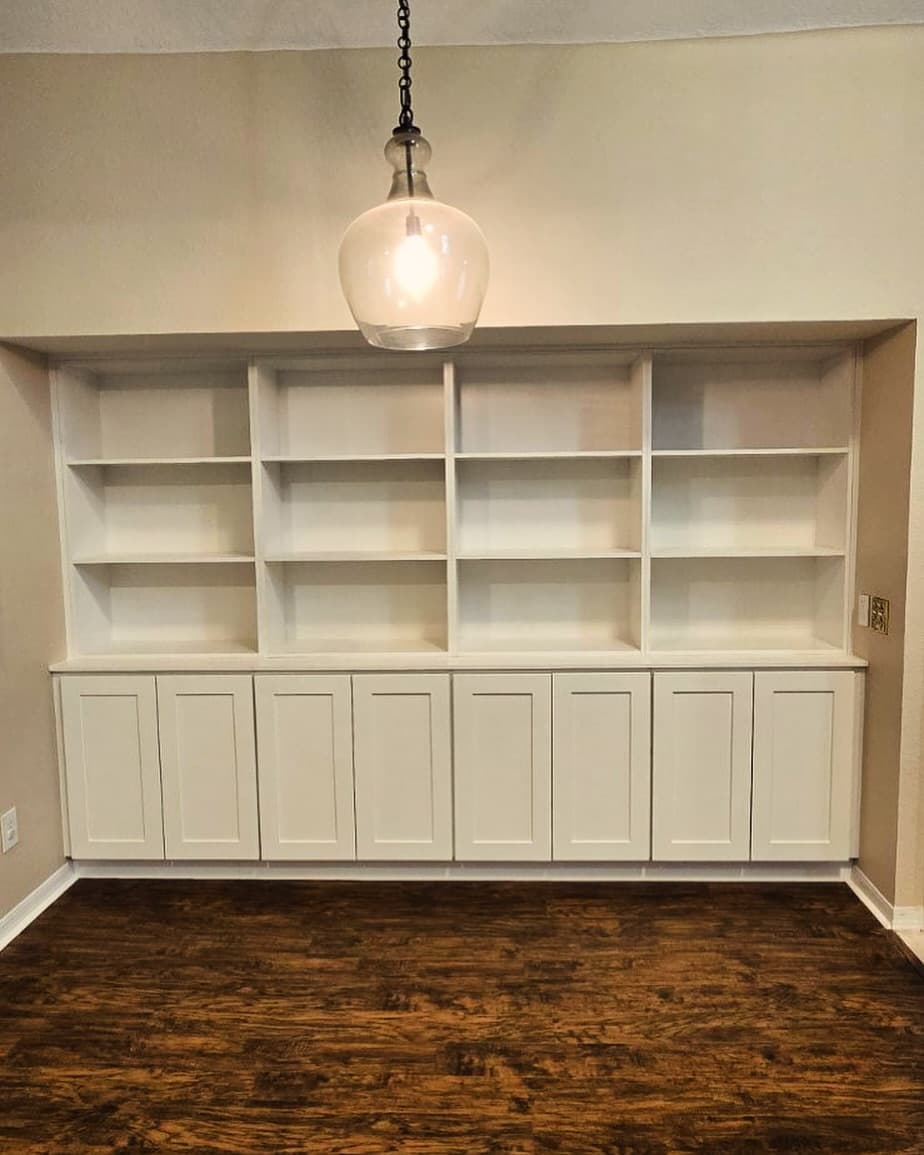
A wall like the white unit above, open shelving over shaker doors, reads as one continuous piece. But a good quote will itemize it honestly: MDF doors, plywood carcasses and shelves, hardwood face frames. If a quote is vague about all of it, that's not always hiding something. It is worth a direct question before you sign, though. For how materials fit into the overall number, our breakdown of what custom work costs in Jacksonville goes deeper.
Bottom line: you're not paying for a slab of exotic lumber. You're paying for the right material in every location, joined and finished carefully. If you've got a quote in hand and want a second set of eyes, or want us to walk through ours line by line, we're glad to do it.
By consultation
Built to last.
Finished to impress.
We take on a limited number of projects each season so each home gets our full attention. Share your project and we’ll respond within 24 hours to see if it’s the right fit.
Insured · $1M general liability · 230+ Google reviews, 5.0